Oluna Ceska (1938-2022) was a Canadian naturalist and mycology researcher. She was also a founder and longterm member of SVIMS. With her husband, Adolf Ceska, she contributed thousands of specimens to the UBC Fungarium, primarily from BriIish Columbia.
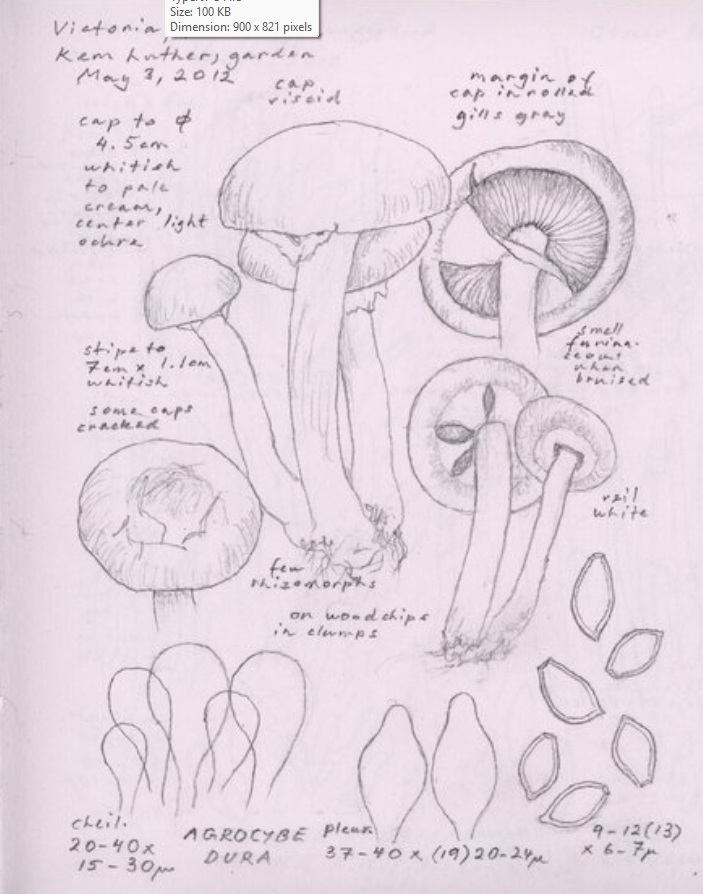
Among their collections are nine sketchbooks by Oluna containing nearly 5,000 mushroom and microfungi drawings created between 1997 and 2021. Through a project coordinated by Ludovic Le Renard, her sketchbooks have been digitized and stored in the the University of Victoria digital vault. Ludo has created an extensive index to the stored documents, allowing users to access individual pages. The index is now stored on the SVIMS Mushroom ID page.
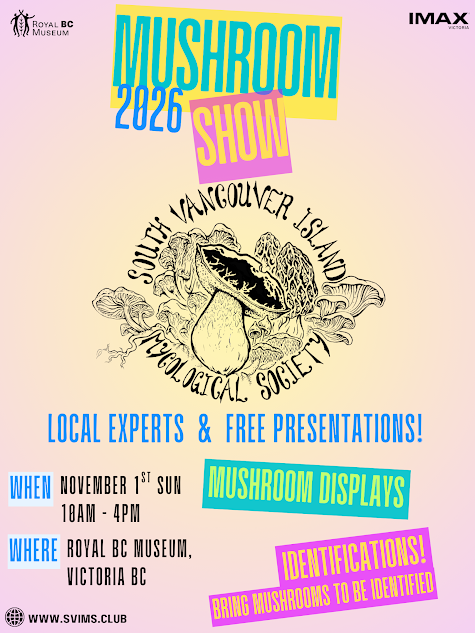
SVIMS big mushroom season events are coming up soon. The annual show is at the RBCM is on Sunday, November 1, 10-4 pm. See poster below.
On the weekend before, October 23-25, is our annual foray in the Cowichan Valley at the Cowichan Lake Conference and Education Centre. Reservations for the overnighting part of the event are no longer available, but there is still spaces in the day options for Saturday, October 24. For more information, see the registration page.
Dr. David Walde, a retired physician with a career in internal medicine, oncology, and hematology, has maintained a lifelong interest in fungi. After moving to Vancouver Island, he became active with the South Vancouver Island Mycological Association and now serves on the Medicinal Mushroom Committee of the North American Mycological Association.
Title:The Amanitas: The Good, the Bad and the Ugly
Few mushroom genera inspire as much fascination or respect as Amanita.
With their striking forms and remarkable chemical diversity, Amanita species range from the familiar and culturally iconic Amanita muscaria, to edible species, and to some of the most dangerous mushrooms in the world. They are responsible for the great majority of deaths from mushroom poisoning.
Dr. David Walde’s upcoming presentation will explore this extraordinary genus from a somewhat different perspective. Rather than suggesting that collectors try to memorize every species in the genus, Dr. Walde proposes that we examine the major groups within Amanita, the toxins that distinguish them, and the very different poisoning syndromes they can produce. Understanding the relationship between identification, chemistry, and clinical symptoms adds a fresh dimension to our field observations. Three of our local species, A. muscaria, A. phalloides, and A. smithiana, provide particularly striking examples.