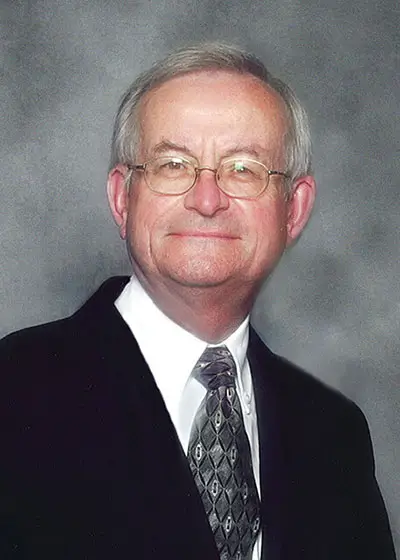
Dr. David Walde, a retired physician with a career in internal medicine, oncology, and hematology, has maintained a lifelong interest in fungi. After moving to Vancouver Island, he became active with the South Vancouver Island Mycological Association and now serves on the Medicinal Mushroom Committee of the North American Mycological Association.
Title:The Amanitas: The Good, the Bad and the Ugly
Few mushroom genera inspire as much fascination or respect as Amanita.
With their striking forms and remarkable chemical diversity, Amanita species range from the familiar and culturally iconic Amanita muscaria, to edible species, and to some of the most dangerous mushrooms in the world. They are responsible for the great majority of deaths from mushroom poisoning.
Dr. David Walde’s upcoming presentation will explore this extraordinary genus from a somewhat different perspective. Rather than suggesting that collectors try to memorize every species in the genus, Dr. Walde proposes that we examine the major groups within Amanita, the toxins that distinguish them, and the very different poisoning syndromes they can produce. Understanding the relationship between identification, chemistry, and clinical symptoms adds a fresh dimension to our field observations. Three of our local species, A. muscaria, A. phalloides, and A. smithiana, provide particularly striking examples.
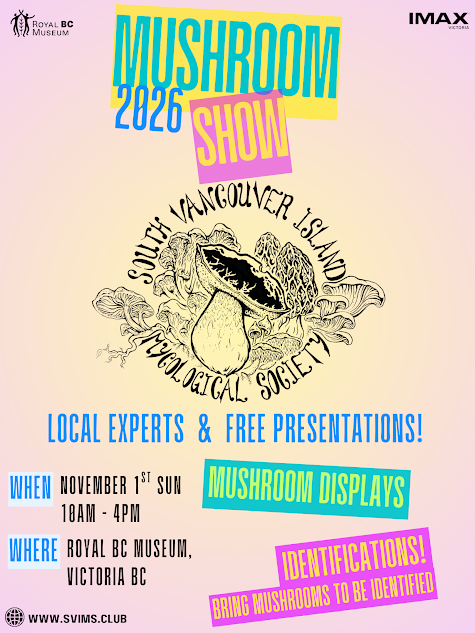
SVIMS big mushroom season events are coming up soon. The annual show is at the RBCM is on Sunday, November 1, 10-4 pm. See poster below.
On the weekend before, October 23-25, is our annual foray in the Cowichan Valley at the Cowichan Lake Conference and Education Centre. Reservations for the overnighting part of the event are no longer available, but there is still spaces in the day options for Saturday, October 24. For more information, see the registration page.
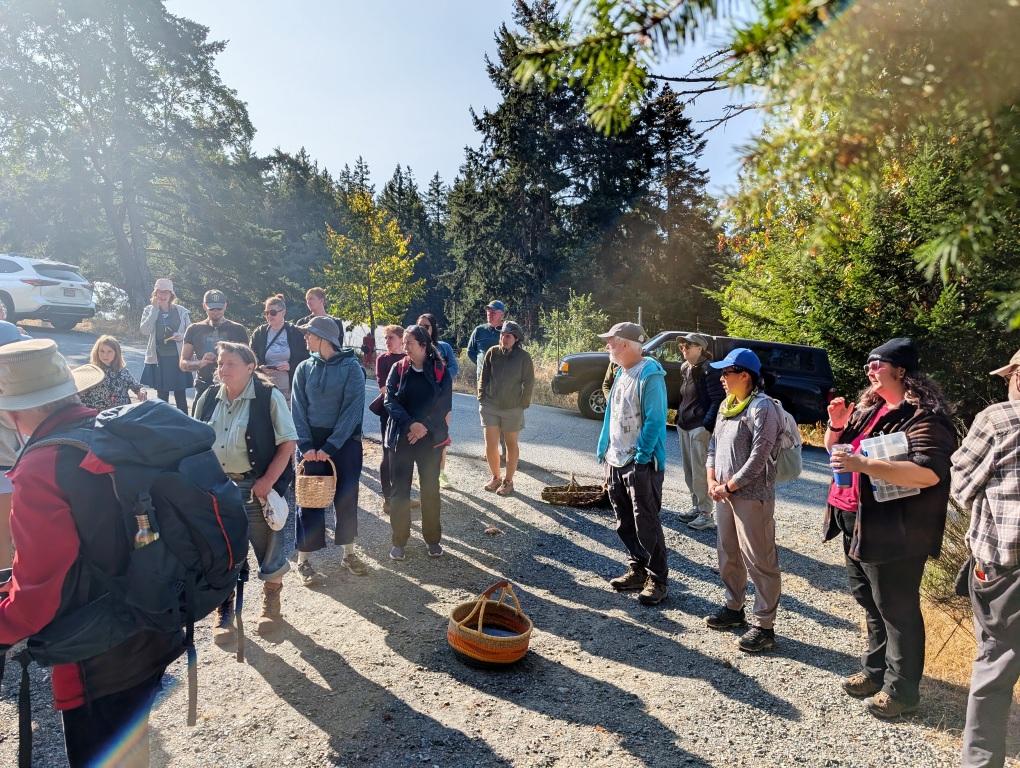
For the first foray of the 2026-2027 season, about 30 SVIMS members convened at Metchosin Wilderness Park. Andy MacKinnon and Mel Hesz (who gave the SVIMS presentation two days before) were group leaders. Several who attended were at their first organized foray.
After a dry summer, mushrooms were thin on the ground. Only about 15 species were found. Seven were collected for sequencing in the BC MycoMap project.
About 300 different species of fungi (not counting lichens) have been in the park over several years of searching. A bit over 75 of these species have been sequenced. Half of the species are species in the full sense of the word. The other half are temp-coded sequences, many of which will some day have their own species names. The sequenced species and temp codes from the park can be seen on this iNaturalist page.
The SVIMS group gathers at the trail head into Metchosin Wilderness Park.
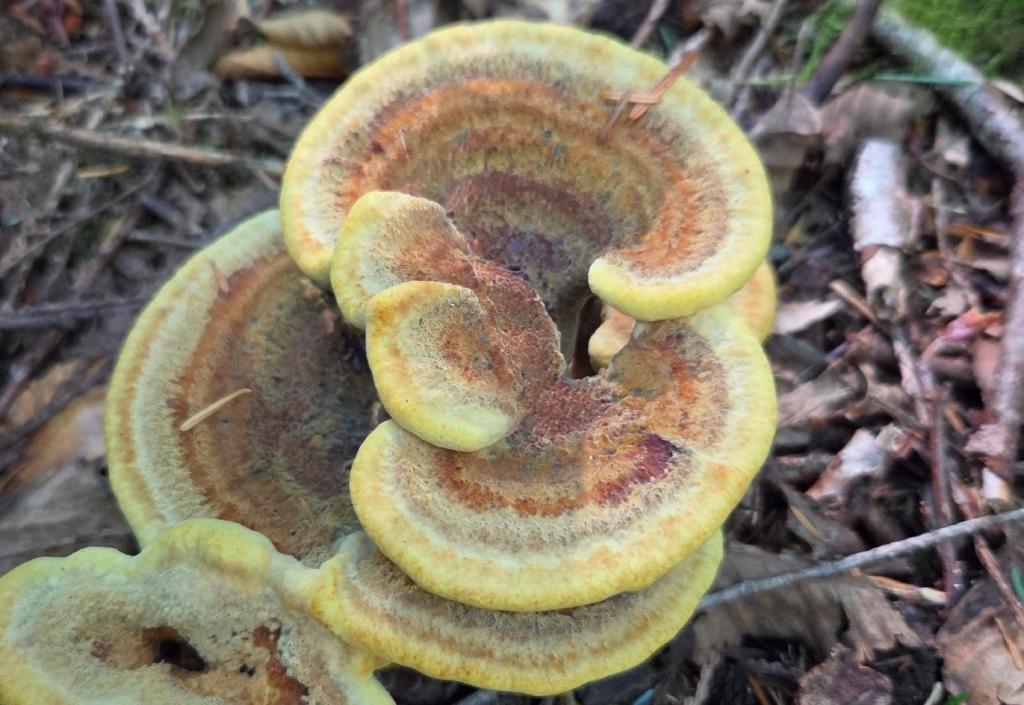
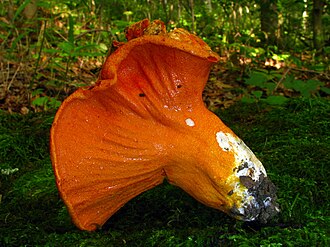
Spotted: a beautiful young Dyer's Conk, photo by Julie
Tina Brown, SVIMS Treasurer and Foray Check-in leader, helps herd the group around the park.
The Thursday, October 1 2026 SVIMS meeting is a two-fer presentation by a pair of young up-and-coming mycologists currently at the University of Victoria. We meet at Pacific Forestry Centre, 506 Burnside Road West, Victoria. Doors open at 6:30 for 7:00 pm start.
Bethany Robson is a graduate student studying Forest Biology at the University of Victoria. She became fascinated with the intersection between stress physiology in trees and mycology in her undergrad, but her love of forests and fungi started when she was very wee.
When she’s not in the lab, she is running, gardening, cooking, or gaming with her crew. Bethany is also passionate about getting kids into STEM (science, technology, engineering and math). She has been the President of the Society for Advancement of Young Scientists since 2023, a non-profit that encourages youth on Southern Vancouver Island to explore the world around them through scientific research.
Presentation
Title: Bucket Chemistry: Using aeroponics to investigate the impact of mycorrhizal fungi on root compounds produced under drought stress
Description: British Columbia is experiencing more frequent drought events, likely due to climate change. Many of our native tree species are not drought tolerant, including Western Redcedar and Bigleaf Maple. Symbiotic (mycorrhizal) fungi reduce drought stress symptoms in many plants, but how and why is not well understood. Plant roots and their mycorrhizae often exude helpful compounds called osmolytes when drought stressed, but these are hard to study because they are produced in an underground environment. In her project, Bethany used a new method–aeroponics–to better understand whether mycorrhizal association in Redcedar and Maple roots improved osmolyte production.
Latina Penkova-Linking is currently completing her Masters at the University of Victoria under the supervision of Dr. Marty Kranabetter and Dr. Barbara Hawkins. She studies fungal enzymes associated with lignin decomposition. During her undergraduate degree, she worked with Dr. Melanie Jones and Dr. Dan Durall, comparing fungal fruiting body communities between an old-growth forest and adjacent clear-cuts 27 years post-harvest.
Her fascination with fungi began long before her research. Growing up in Eastern Europe where mushroom foraging is deeply ingrained in culture and community, she developed a love for exploring forest floors and discovering what grows there. Fungi have remained her greatest curiosity ever since.
Presentation
Title: Linking Ectomycorrhizal Fungal Species, Manganese Peroxidase Genes, and their Enzymatic Activity in Coastal Douglas-fir Forests.
Description: Forests are some of our most important carbon stores, but what happens beneath the forest floor can determine whether that carbon stays locked away in the soil or is released back into the environment. Fungi are major players in this process. Ectomycorrhizal fungi form partnerships with trees, exchanging nutrients from the soil for carbon produced by their hosts. Traditionally, the work of decomposing dead plant material has been attributed largely to saprotrophic fungi, the forest’s decomposers, while ectomycorrhizal fungi were viewed primarily as nutrient-trading partners of trees. However, growing evidence suggests that some ectomycorrhizal fungi have retained part of the decomposing machinery of their saprotrophic ancestors. This challenges the idea of a clear divide between fungal decomposers and tree symbionts and instead suggests that decomposition ability may exist along a continuum.
Latina’s research explores whether certain ectomycorrhizal fungi can help break down tough organic matter, like lignin, using enzymes such as manganese peroxidase. Working in coastal Douglas-fir forests on southern Vancouver Island, she combines DNA sequencing with enzyme assays to investigate which ectomycorrhizal fungi are potential enzyme producers and what genes associated with decomposition they possess.
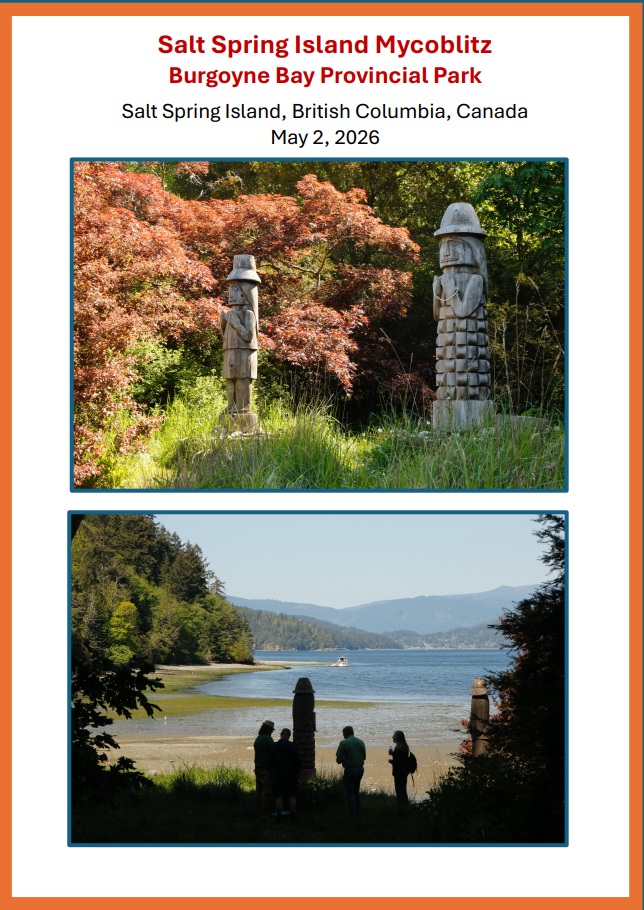
On May 2nd, 2026, members of Mushroom Enthusiasts of Salt Spring Island and South Vancouver Island Mycological Society conducted a mycoblitz in Burgoyne Bay Provincial Park, Salt Spring Island, British Columbia, Canada.
Burgoyne Bay Provincial Park in the Southern Gulf Islands contains wooded Douglas-fir forests, threatened Garry oak trees, rocky shorelines, open grasslands, culturally significant sites (First Nation middens and gathering places), and a number of old and historic farm buildings.
The event was organized by Vail Paterson, and attended by about 20 members of the Mushroom Enthusiasts group. Attending from SVIMS were Meagan Kikcio, Andy MacKinnon, Ann McCall, Joseph Kehx McLean, Kem Luther, and Ruth Norfolk.
Because of the unusually dry spring, mushrooms were a bit thin on the ground.
Salt Spring’s Rosemarie Keough produced a detailed and beautiful report of the event that includes photos of the mushrooms found.
Thursday, September 3, 2026, Pacific Foresty Centre.
Would you like like to understand what you need to know in order to identify your mushrooms more consistently? How about what to forage for, and how and where?
Mel’s talk will empower you to feel more comfortable identifying mushrooms (It takes time, folks!) and what to forage for.
Melanie Hess is a BC-born-and-raised, all-around-outdoors woman, mycology enthusiast, local mushroom Identification educator, and forager. She is past-president and multitask volunteer for SVIMS. Mel, educated through long experience, has had the pleasure of learning shroomy tricks and tips from local mycologists and more distant experts. Treasure hunting in the woods is her favorite hobby!
SVIMS own Elora Adamson will be co-presenting an online workshop prior to the NAMA Annual Foray in Marquette, Michigan (August 27-30, 2026). The presentation will be on:
Using iNaturalist to Make Fungi Collections
The workshop will focus on using iNaturalist to create high-quality fungal records that can support DNA sequencing and voucher of specimen collections. Participants will learn the basics of using iNaturalist on both mobile devices and computers, along with tips and best practices for uploading observations. The workshop will also cover applications of iNaturalist specific to mycology.
The workshop will be at 5 pm Pacific time on Monday, July 27, 2026. Workshop is free, but you need to register. More information on the workshop web site.